
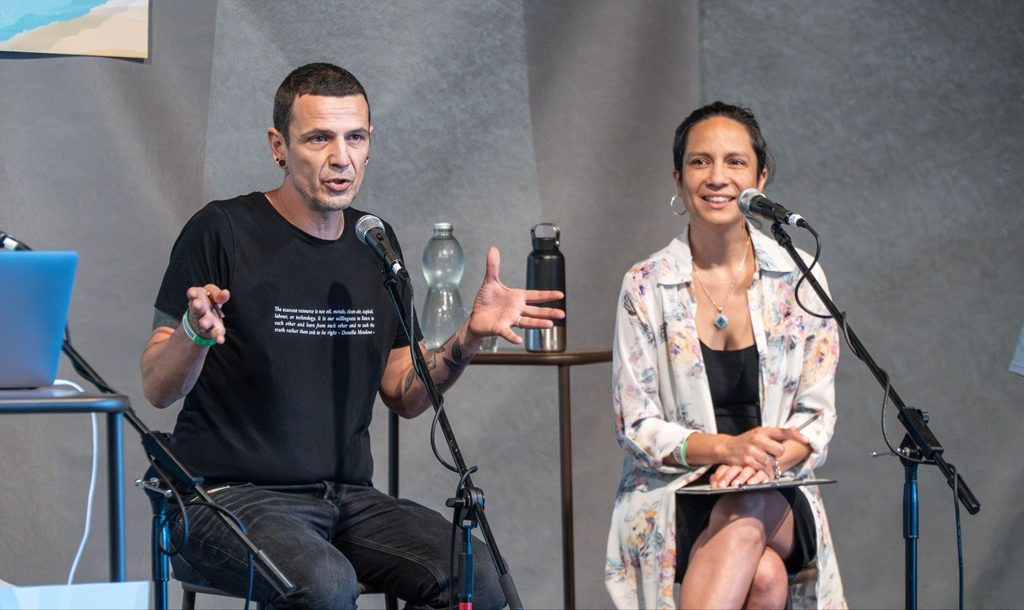
This article draws on an online conversation between Leila Araghi and Resilience Earth co-founders Oscar Gussinyer and Erika Zárate in early 2026.
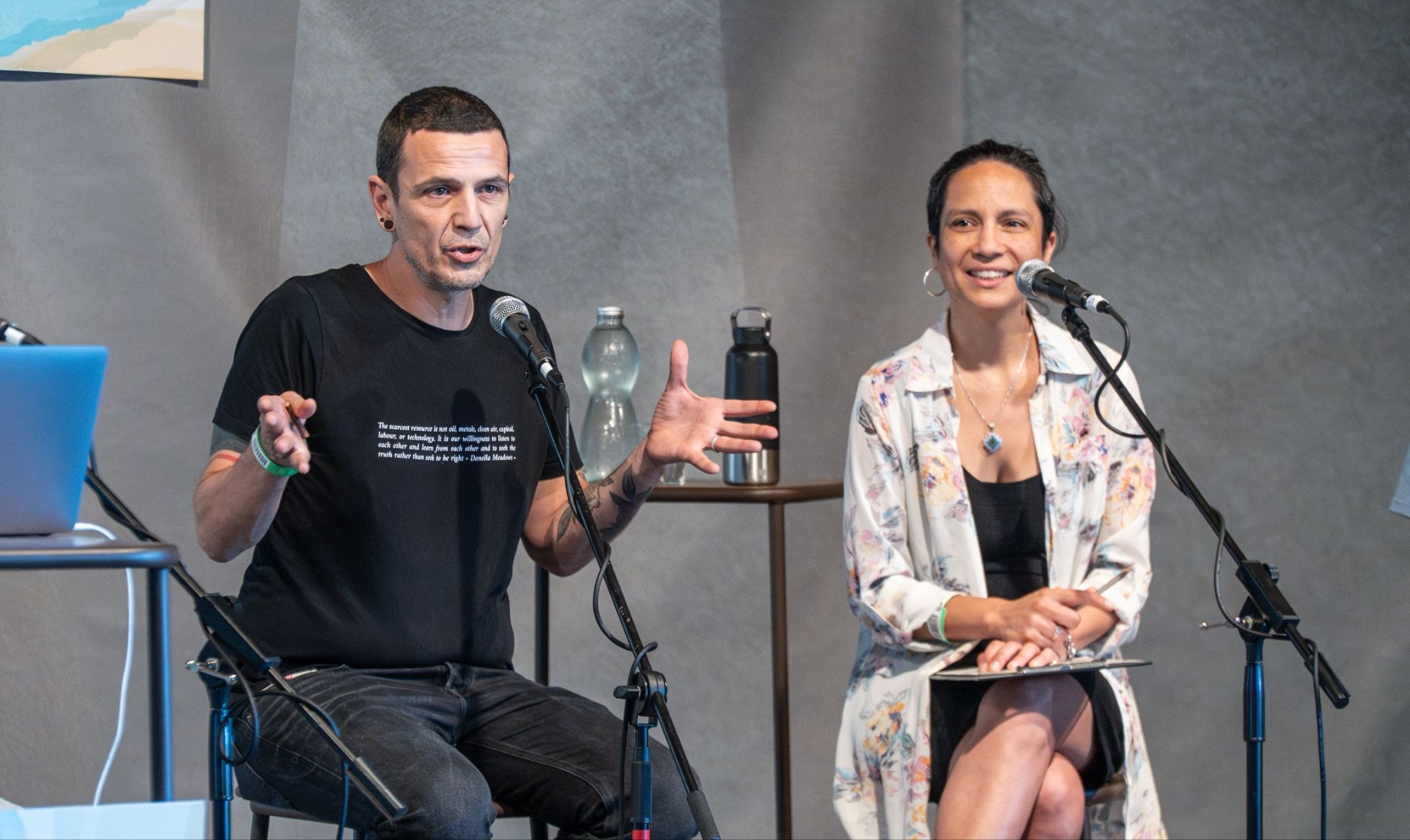
Resilience Earth is a regenerative consultancy and cooperative based in Catalonia, Spain, working with rural communities, regional governments, cooperative ecosystems, human rights organisations and social movements. Much of its work comes down to a question that is easy to overlook: how do people organise themselves to make decisions and act together?
For Resilience Earth, governance is at the heart of many challenges facing communities and organisations. Whether the issue is funding, strategy, collaboration or participation, the ways people make decisions and exercise authority can shape what becomes possible. Decisions are sometimes made far from the people who understand a situation or will live with the consequences.
Co-founders Oscar and Erika approach this work by paying attention to the history, relationships and tensions of each place. It is also what drew them to Sociocracy 3.0 (S3): not a ready-made governance model, but a collection of patterns they could learn from and adapt to the circumstances in front of them.
Working with patterns, not implementing a model
Before discovering S3, the Resilience Earth team had already been exploring classic sociocracy and systems thinking. Oscar recalled finding some of the approaches they encountered too rigid for the different settings in which they worked. A process that is useful for a three-person cooperative may be inappropriate for a much larger regional ecosystem.
What appealed to the team about S3 was its pattern-based approach. Oscar describes it as “an adaptive architecture” that practitioners can adjust according to what is emerging, rather than a model that has to be adopted in full.
“The pattern needs to be at the service of the needs of the community, not the other way around.”
— Oscar Gussinyer
Oscar is wary of governance models arriving with what he calls a “colonising mindset”: telling communities there is one correct way to organise rather than helping a place develop on its own terms. This perspective closely reflects the S3 pattern Adapt Patterns to Context. For Resilience Earth, the starting point is to understand what people are trying to achieve, what is getting in the way, and which interventions might help.
Erika highlights a related danger: turning a useful approach into a rigid procedure. She recalled observing a sociocracy implementation where meetings had become so formalised that a discussion taking about 20 minutes at Resilience Earth could take an hour and a half. The problem, in her view, was not structure itself, but structure getting in the way of the work it was meant to support.
In practice, the team might strengthen communication and representation where trust is weak, or create simple spaces for coordination where people are disconnected. They may not mention S3 explicitly. Its patterns have become part of how they notice possibilities and respond to local needs.
The S3 idea of Navigate via Tension offers a useful parallel: pay attention to what people notice about their situation, rather than beginning with a predetermined solution. That does not mean every Resilience Earth practice is an S3 pattern. S3 is one source of ideas within their wider practice.
A regional initiative: when participation meets political power
One experience shared during the session illustrates both the potential and the limits of this approach. Resilience Earth supported a regional initiative spanning more than twenty municipalities and affecting tens of thousands of residents. Several thousand people participated in developing a strategic framework aligned with the UN Sustainable Development Goals and adapted to local realities.
Bringing people into strategic planning was significant, but the team wanted the results to have a life beyond the project.
“If you don’t embed the strategic planning inside governance structures that help it stay alive, then it just becomes another strategic plan sitting in a drawer.”
— Oscar Gussinyer
Resilience Earth proposed an interconnected governance structure in which people from areas such as health, the economy, civil society, public services and local institutions could collaborate across the region. Different hubs would take responsibility for particular areas while remaining connected to the larger system.
The proposal drew on ideas related to domains and delegation, Linking and Fractal Organisation. These were design influences, not evidence that a complete S3 structure was implemented. The intention was to make participation and responsibility durable, rather than dependent on a temporary consultation process.
As the proposal began to raise questions about who would influence or make decisions, resistance emerged. Oscar recalled political representatives questioning what their own role would be if the proposed arrangements were established. This is his account of their response, rather than an account from the representatives themselves.
The strategic planning work was delivered, but the more ambitious governance changes did not move forward as envisaged. The information shared during the session does not establish what, if anything, was subsequently adopted from the proposed structure.
For Resilience Earth, the experience brought home how political governance design can be. Broader participation can challenge established expectations about representation, legitimacy and authority. Oscar described a key lesson for the team: people likely to oppose a proposed change need to be involved early, rather than overlooked until their concerns become an obstacle.
This connects with Involve Those Affected. It is not simply a matter of inviting more people into the room, but of recognising whose interests and authority might be affected, including those who might disagree with the direction of the work.
Governance as adaptable code
Another image that emerged during the conversation was governance as code: something that can be examined, adapted and developed rather than treated as an unchangeable set of instructions.
Organisations and communities already operate according to governance arrangements, whether these are written down or not. Someone decides which issues matter, who may participate, how resources are allocated and what happens when people disagree. Some of these arrangements are visible; others are embedded in habits and relationships.
Oscar sees S3 as one way to become more conscious of those arrangements and more capable of changing them. He calls practitioners “governance hackers”: people who can notice how a system works and experiment with making it more transparent, flexible and inclusive.
The metaphor does not mean there is a universal set of instructions waiting to be installed. Nor does it replace local experience and knowledge. Its value lies in giving people a language for possibilities they can test and revise together.
For Erika, this is also a matter of judgement: recognising what a situation calls for instead of following a method because it is familiar. Her concern about over-formalised meetings is one example of what can happen when the method becomes more important than the need it was intended to address.
“You need to sense the field and design the governance model the system needs. Not impose it.”
— Erika Zárate
The team also makes space for disagreement rather than expecting everyone to converge on the same view. Oscar encouraged people to “nourish disagreement.” Different perspectives can reveal information a community needs in order to decide wisely, especially when decisions affect how power and responsibility are shared.
Learning through practice
Asked what they would recommend to people discovering S3, both co-founders encouraged experimentation rather than trying to master every pattern before beginning. Oscar urged people to apply what they learn, expect mistakes and resist the pressure to get everything right from the start.
Erika offered a complementary invitation, emphasising curiosity and playfulness.
“There’s something playful about it. Stretch into it. Shape it to what you really need.”
— Erika Zárate
This does not mean acting carelessly or disregarding consequences for others. It means starting with a real situation, trying something appropriate to its scale, noticing what happens and developing the approach through experience.
For Resilience Earth, the value of S3 is not measured by how many patterns a community can name or how closely its structures resemble a particular model. What matters is whether people become more able to see what is happening, take part in decisions, address disagreement and work together on what matters to them.
With experience, the patterns can become less like instructions and more like a way of noticing and responding. That is what Oscar’s metaphor ultimately points to: “You have the code inside you.”